

Asana vs Monday.com
Asana vs monday.com: Which Should You Choose?
Asana and monday.com both have a free plan and a free trial, both are rated Medium difficulty, and both list annual pricing per person. The split is in what each page lists as everyday work. Asana lists goal tracking and marketing campaigns. monday.com lists operations tracking and resource planning. The choice depends on whether your team plans around projects and goals, or around processes and capacity.
Choose based on how you work
Choose Asana if…
Choose Asana if your team needs clear project ownership, deadlines, dependencies, and repeatable workflows without building a highly customized system from scratch.
View Asana details →Choose monday.com if…
Choose monday.com if your team wants visual boards, dashboards, automation, and customizable workflows that can adapt across departments.
View monday.com details →See the products side by side
Compare the actual interfaces to see how each tool approaches everyday work.
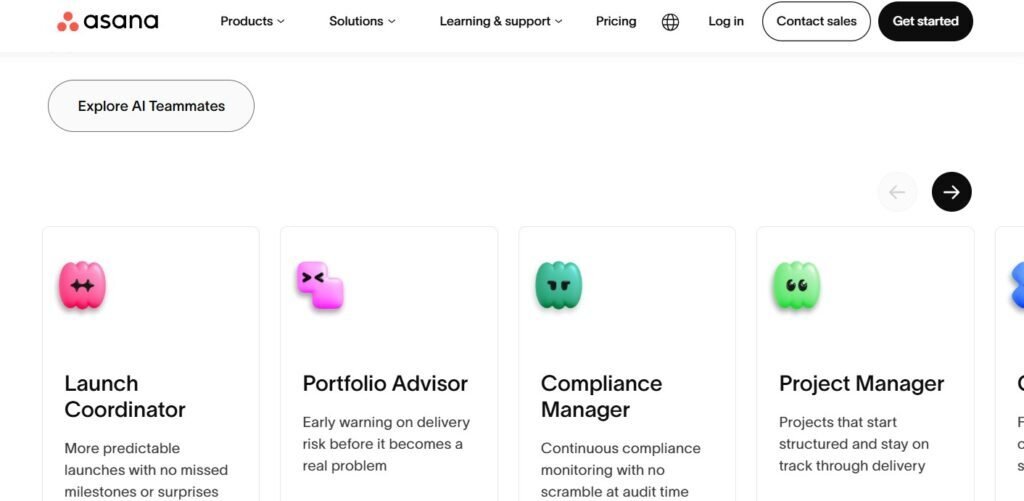

Asana vs monday.com comparison
| Compare | Asana | monday.com |
|---|---|---|
| Starting price | $10.99/user/mo billed annually | $9/seat/mo billed annually |
| Free plan | Yes | Yes |
| Free trial | Yes | Yes |
| Difficulty | Medium | Medium |
| Best for | Teams that want structured project management with clear ownership, deadlines, workflows, goals, and cross-project visibility. | Teams that want visual project and process management with customizable boards, dashboards, automations, and cross-team workflows. |
| Key strength | Strong balance of usability and structure for coordinating projects, responsibilities, timelines, and team goals. | Flexible visual boards and dashboards make it easy to model many different business processes without code. |
| Main limitation | The free plan is limited to two users, and many advanced workflow, reporting, and portfolio features require paid tiers. | Pricing and seat structure can become expensive for small teams, especially when advanced automation, reporting, or multiple monday products are needed. |
| Last checked | Oct 2026 | Oct 2026 |
Where each tool wins
Where Asana wins
- Goal tracking is a listed use case, and monday.com's list has none.
- Marketing campaigns are named as a use case, where monday.com's list says marketing workflows.
- Multiple project views are named in the pros list.
- Goals and portfolios are available on higher plans.
- A large integration ecosystem is named as its own strength.
Where monday.com wins
- The listed price is lower: $9/seat/mo, against $10.99/user/mo for Asana, both billed annually.
- Operations tracking is a listed use case, and Asana's list does not include it.
- Resource planning is a listed use case, and Asana's list does not include it.
- Many templates are named in the pros list.
- Mobile apps are named in the pros list, and Asana's list does not mention them.
What can you use them for?
Asana
- Project management
- Marketing campaigns
- Team planning
- Workflow management
- Goal tracking
- Cross-functional coordination
monday.com
- Project management
- Operations tracking
- Marketing workflows
- Team dashboards
- Process management
- Resource planning
Trade-offs to consider
Asana
What we like
- Clean project structure
- Strong task ownership and deadlines
- Multiple project views
- Good workflow builder
- Useful goals and portfolios on higher plans
- Large integration ecosystem
What to consider
- Free plan limited to 2 users
- Advanced reporting and portfolios require higher plans
- Can become expensive as teams grow
monday.com
What we like
- Flexible visual boards
- Strong dashboards
- Good automations and integrations
- Many templates
- Works across project and operational workflows
- Mobile apps
What to consider
- Seat-based pricing can be costly
- Free plan limited to 2 seats and 3 boards
- Advanced features require higher tiers
What decides it
Asana or monday.com?
Asana
Choose it if: Choose Asana if your team needs clear project ownership, deadlines, dependencies, and repeatable workflows without building a highly customized system from scratch.
Skip it if: Skip Asana if you need a generous multi-user free plan, a deeply customizable database workspace, or an all-in-one system that also replaces team chat and documentation tools.
monday.com
Choose it if: Choose monday.com if your team wants visual boards, dashboards, automation, and customizable workflows that can adapt across departments.
Skip it if: Skip monday.com if you have a very small team with simple task needs, need a generous free plan, or want predictable low-cost pricing without seat-based expansion.
Frequently asked questions
Which one is cheaper?
monday.com is listed at $9/seat/mo and Asana at $10.99/user/mo, both billed annually. The page does not compare what each plan includes.
Do they have a free plan or trial?
Yes. Both have a free plan and a free trial.
What are the limits of the free plans?
Asana's free plan is limited to 2 users. monday.com's is limited to 2 seats and 3 boards.
Which one is easier to learn?
Both are rated Medium.
Which one is better for goal tracking?
Asana lists goal tracking and names goals and portfolios on higher plans. monday.com's use case list does not include goal tracking.
Which one is better for operations and resource planning?
monday.com lists operations tracking and resource planning. Asana's use case list does not include them.
Which one is better for marketing teams?
Asana lists marketing campaigns and monday.com lists marketing workflows, so both cover marketing use cases.
Do both have mobile apps?
monday.com lists mobile apps in its pros. Asana's list does not mention them.
Do both connect to other apps?
Yes. Asana names a large integration ecosystem, and monday.com names good automations and integrations.
Who should skip each one?
Skip Asana if you need a generous multi-user free plan, a deeply customizable database workspace, or a tool that replaces team chat and documentation. Skip monday.com if you have a very small team with simple needs, need a generous free plan, or want low-cost pricing without seat-based expansion.
Compare any two tools
Use the interactive comparison tool for combinations that do not have a permanent guide yet.